Every Western buyer is asking the same question. Very few people have counted the answer.
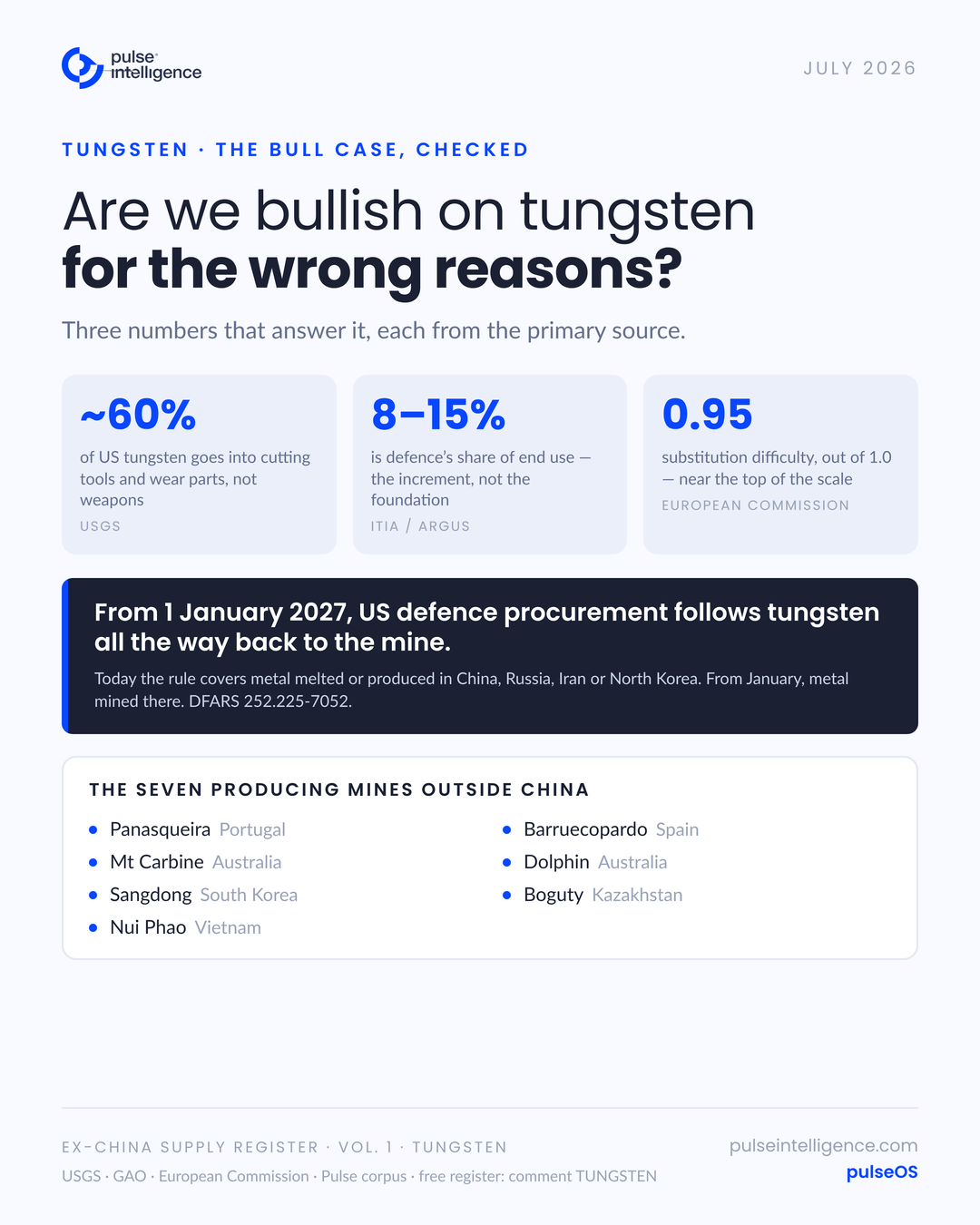
On 1 January 2027, one clause of US defence procurement law changes by a handful of words.
Today, DFARS 252.225-7052 bars contractors from delivering tungsten metal powder or tungsten heavy alloy that was melted or produced in China, Russia, Iran or North Korea. From 1 January 2027 it bars tungsten mined, refined, separated, melted or produced in those countries.
The compliance question moves from the smelter to the mine. That is five months away, and it applies to a metal whose supply has been concentrated in one country for a generation.
Tungsten has also spent the last nine months doing what critical minerals do when the country that controls the supply decides to control it more tightly. The price went vertical, the equities followed, and a lot of people who had never thought about tungsten started thinking about it very hard. Then the price halved, and most of them stopped.
The price will do what it does. The deadline will not move. Underneath both sits one question that matters to a procurement officer, a defence prime, a policy team, a fund manager or a corporate development desk:
Who can credibly supply tungsten from outside China, and when?
That question is answerable. It just requires someone to count.
Nobody had. So we did — and this is the first of a series doing the same for the critical minerals where the West has a supply problem and no published inventory.
But before the count, a detour that changed how we read it. Almost everything being said about why tungsten matters turns out to be wrong — and what is left standing is a stronger case than the one being sold.
01 The demand story, checked against primary sources
Four claims turn up in almost every piece written about tungsten in the last year. We went looking for the primary source behind each.
"The 155mm artillery surge is driving tungsten demand." The US Army's M795 — the round at the centre of the Western ammunition build-out — is a high-fragmentation steel projectile. HF1 steel body, gilding metal rotating band. There is no tungsten in it. The most heavily covered ammunition programme in the West is not a tungsten story.
"Tank penetrators are tungsten." Not American ones. The Pentagon's own Director of Operational Test & Evaluation describes the M829A4 — the current-issue Abrams round — as "a depleted uranium long-rod penetrator with a three-petal composite sabot." Germany's newest 120mm round, KE2020Neo, does use a tungsten heavy-alloy penetrator, but that reflects German legal restrictions on depleted uranium rather than a reassessment of the metal. The tungsten-penetrator market is largely a non-US NATO market.
"Defence is the demand story." The International Tungsten Industry Association put defence at 8% of global end use on 2021 data. Argus's Cristina Belda estimated roughly 12% in 2026, rising toward 15% by 2027-28. Those two figures conflict and we are not going to average them. Either way, the USGS number that dwarfs both has been stable for years: an estimated 60% of US tungsten consumption goes into cemented carbide parts for cutting and wear-resistant applications. Tungsten is an industrial machining metal that defence buys a slice of. It is a tooling cycle wearing a defence costume.
"There is no substitute." USGS lists substitutes for every major category — cemented carbides based on molybdenum, niobium or titanium carbide; ceramics; cermets; tool steels; molybdenum for mill products and tool steels; LEDs for filaments; depleted uranium or hardened steel for penetrators. The accurate version is USGS's own sentence: most of these options "reduce, rather than replace, the amount of tungsten used," and substitution "would result in increased cost or a loss in product performance." The European Commission's 2023 assessment scores tungsten's Substitution Index at 0.95 out of 1.0 — near the top of the difficulty scale. That is a genuine moat, and it is worth describing accurately rather than as an absolute.
One end-use has in fact been structurally destroyed by substitution: lighting. Tungsten filament demand fell from roughly 10–20% of US consumption around 1997–2000 to under 8% by 2019, on USGS's own numbers, as LEDs displaced incandescents. It took two decades, it required a genuinely superior technology, and it took out a minority application. Cemented carbide was the core then and still is.
So does knocking down the defence story make the case for tungsten weaker?
It makes it more durable. Every claim that failed above was a defence claim, and defence demand is the cyclical, budget-dependent, politically reversible part of any critical minerals story. Take it out of the foundations and what remains is an irreplaceable industrial input with roughly 60% of its demand in the global machining base — aerospace, automotive, oil and gas, mining, general manufacturing — with a quantified substitution moat, and with defence sitting on top as a growing increment rather than holding the thing up. A commodity whose bull case rests on procurement budgets is a bet on politics. Tungsten's rests on whether the world keeps cutting metal.
02 What is actually true
Two facts survived the check, and both are more interesting than the ones that did not.
The US emptied its tungsten stockpile, then went shopping. Between fiscal 2019 and 2023 the National Defense Stockpile recorded, in the GAO's phrasing, "a 100 percent decrease in tungsten alloys." It went to zero. USGS now lists tungsten among the stockpile's potential acquisitions at 2,041 tonnes for FY2025 — roughly 2.4% of world mine production, sought by a single buyer, in a country that has not mined tungsten commercially since 2015, imports over half of what it consumes, and sources 26% of those imports from China.
The binding constraint is the converter, not the mine. Outside China there are only about five operating APT converters: Global Tungsten & Powders (Towanda, Pennsylvania, plus Czech and Finnish sites), Wolfram Bergbau und Hütten (Austria), H.C. Starck (Germany), Masan High-Tech Materials (Vietnam), and toll converters such as NIC Resources in Japan. Two of those — GTP and Wolfram Bergbau — share a single parent, Plansee Group. GTP's management told the Philadelphia Inquirer in February 2026 that it could produce 50–60% more and was sold out six to nine months ahead.
China's share of APT and downstream processing is generally put at around 80%, at or above its share of mine production. No statistical agency publishes that figure the way USGS publishes mine production, so treat it as well-corroborated trade estimate rather than official data. The direction, though, is not in dispute — and it is visible in what China chose to control. The February 2025 export controls named APT, tungsten oxide, tungsten carbide and tungsten alloys. Not concentrate. A country whose leverage sits in processing controls processed products.
This matters for everything that follows. A new Western mine has a very short list of buyers who can turn its concentrate into powder. Counting mines is necessary. It is not sufficient.
03 The universe is smaller than the noise suggests
The Pulse corpus holds 150 mining assets where tungsten is the primary commodity, across 19 countries. A further 441 assets outside China carry tungsten as a secondary or by-product commodity (468 including China) — mostly sitting inside gold (144), lithium (109), copper (70) and tin (51) deposits, where tungsten is a credit line rather than a reason to build a mine.
So: 618 assets touch tungsten. Only 150 are actually about tungsten.
Strip out China and you are left with 106 records carrying tungsten as the primary commodity — a deduplicated count, after removing twelve child deposits sitting under a parent already on the list and merging one Kazakh mine (Boguty/Bakuta) that had been entered twice. The country distribution below is on that record count:
| Country | Assets | Producing |
|---|---|---|
| United States | 31 | 0 |
| Australia | 27 | 2 |
| Canada | 19 | 0 |
| Spain | 8 | 1 |
| Portugal | 3 | 1 |
| Kazakhstan | 2 | 1 |
| Vietnam | 2 | 1 |
| South Korea | 1 | 1 |
| Other (10 countries) | 13 | 0 |
The United States has the largest single-country inventory of primary tungsten assets outside China — thirty-one of them — and not one is in production. Canada holds nineteen, and the same is true there.
That is the shape of the problem in one line. The West is not short of tungsten ground. It is short of tungsten mines.
04 The funnel: a hundred-odd properties, seven mines
Counting assets is easy and slightly dishonest. An asset is a name on a map. What matters is how far each one has actually travelled toward producing a tonne of concentrate.
Here is the attrition across the non-Chinese records, using the milestone flags carried on each one:
| Stage gate | Assets clearing it |
|---|---|
| Primary tungsten assets outside China | 106 |
| Maiden resource declared | 33 |
| Any economic study published (scoping / PEA / PFS / DFS) | 22 |
| Pre-feasibility or feasibility published | 15 |
| Mining permit granted | 15 |
| Operating mines today | 7 |
Two-thirds of the universe — sixty-nine of the 106 records — has never declared a resource, and 46 are still at grassroots or drilling stage, the part of the lifecycle measured in decades, not quarters.
And at the end of it: seven mines.
05 The seven
These are the primary tungsten mines currently in production outside China, as carried in the corpus:
| Mine | Country | Operator | Note |
|---|---|---|---|
| Panasqueira | Portugal | Almonty Industries | First production recorded 1896 |
| Barruecopardo | Spain | EQ Resources | Restarted 2019; reported a record quarter to June 2026 |
| Mt Carbine | Australia | EQ Resources | Restarted 2023; A$39m expansion approved June 2026 |
| Dolphin | Australia | Group 6 Metals | Restarted 2023; second consecutive cash-flow-positive quarter to June 2026 |
| Sangdong | South Korea | Almonty Industries | Processing operations commenced 1 July 2026 |
| Boguty (also carried as Bakuta) | Kazakhstan | Zhetisu Volframy LLP | Chinese-controlled — see below |
| Nui Phao | Vietnam | Masan High-Tech Materials | Largest tungsten mine outside China |
Read that table twice.
One of the seven is Chinese-controlled. Two of the others are held by a single company, Almonty. Three of them are restarts of assets that had already been mined and shut: Barruecopardo, Mt Carbine and Dolphin all came back rather than being found. Nobody discovered their way out of this shortage.
A further three sit on care and maintenance: Los Santos in Spain, Currais Novos in Brazil, and RHA in Zimbabwe. They are the nearest thing the sector has to spare capacity, and each one stopped for a reason worth understanding before assuming it can simply be switched on.
The Kazakh asset is worth pausing on, because it is where "outside China" and "not Chinese" come apart most sharply — and where our own first pass went wrong.
Boguty and Bakuta are the same mine, operated by Zhetisu Volframy LLP in the Yenbekshikazakh district east of Almaty. It reached Phase I commercial production in April 2025 at 3.3Mtpa of ore, rising to 4.95Mtpa by 2027. Company filings citing Frost & Sullivan describe it as the largest open-pit tungsten mine in the world by WO₃ resources. The ownership is a chain rather than a single holder: Jiaxin International Resources Investment holds 97% of the operating entity through Aral-Kegen LLP, and Jiangxi Copper holds 30.11% of Jiaxin itself, diluted from 41.65% before Jiaxin's August 2025 IPO.
So the Chinese exposure here is one structure with two layers, not two separate positions. Anyone running an "outside China" screen and believing they have run a "not Chinese" screen will reach the wrong shortlist.
Boguty is not the only place the two screens diverge. Pulse carries a royalty over the Dolphin mine in Tasmania — an Australian asset, operated by Group 6 Metals — held by China's Hunan Nonferrous Metals. A royalty is a quieter exposure than a 97% operating stake, and an equity screen alone will not surface it. "Outside China" is a geography; "not Chinese" is an ownership question; they are answered in different columns.
06 The pipeline, and how old it is
Twenty-two non-Chinese tungsten assets have published an economic study of some kind. Here are the ones carrying a stated post-tax NPV or capital cost, ordered by study date:
| Project | Country | Operator | Study | Study date | NPV (US$m) | Capex (US$m) | IRR |
|---|---|---|---|---|---|---|---|
| Watershed | Australia | Tungsten Mining | PEA | Jun 2026 | — | 192 | — |
| Pilot Mountain | United States | Guardian Metal Resources | PFS | Jun 2026 | 660 | 289 | 60% |
| Redmoor | United Kingdom | Strategic Minerals | Scoping | May 2026 | 1,540 | — | 40% |
| Springer | United States | — | Scoping | Apr 2026 | — | 50 | — |
| Borralha | Portugal | Allied Critical Metals | PEA | Apr 2026 | 134 | 91 | 27% |
| Mt Mulgine | Australia | Tungsten Mining | Scoping | Nov 2025 | 505 | 276 | 28% |
| Hemerdon | United Kingdom | Tungsten West | Feasibility | Oct 2025 | 190 | 93 | 29% |
| Bakuta | Kazakhstan | Jiaxin International (97%) | Mine plan | Aug 2025 | 1,342 | 316 | — |
| Pohla-Globenstein | Germany | Saxony Minerals (private) | Scoping | Aug 2025 | — | 29 | — |
| Vila Verde | Portugal | Allied Critical Metals | Scoping | Oct 2024 | 37 | 5 | 45% |
| Molyhil | Australia | — | Feasibility | Aug 2018 | 73 | 50 | 59% |
| Valtreixal | Spain | Almonty Industries | PFS | Oct 2015 | 13 | — | 21% |
| Sisson | Canada | — | Feasibility | Jan 2013 | 417 | 578 | 16% |
| Victorio | United States | Spartan Metals | PEA | 2008 | 271 | — | 15% |
These figures are not comparable to each other and should not be added up. Each was struck on its own price deck, its own cost base, its own discount rate and its own date. A 2013 feasibility study on Sisson and a June 2026 pre-feasibility on Pilot Mountain are answering the same question in two different worlds.
That is the point of showing the study date column. Four of the studies above were published before 2019. One is eighteen years old. Any table of "tungsten developer NPVs" that omits the vintage is telling you a story rather than giving you a number.
Only fifteen non-Chinese tungsten assets have reached pre-feasibility or better. That is the entire realistic near-term Western pipeline, and most of it still needs permits, capital, and an offtake counterparty willing to underwrite a price that has been extremely volatile.
07 The financing reality
Sixty listed companies own a primary tungsten asset somewhere in the corpus. The market has already made its judgment on most of them.
Of the 54 with three-month share price data, 44 are down over the last three months. Of the 45 with a computable cash position, 17 have under six months of runway and 23 have under twelve.
That is the constraint nobody puts in the newsletter. Tungsten's Western development pipeline is held largely by companies whose ability to fund a mine depends on issuing equity into a market that has just re-priced them downward. Ground does not become supply without capital, and a scoping study with a 40% IRR is not capital.
The exceptions are visible in the same data. Almonty — which operates two of the seven producing mines — relocated its head office to Montana in April 2026, joined the Russell 1000 in June, priced a US$700m convertible note offering in June, and in July expanded its Sangdong offtake agreement with Global Tungsten & Powders to a stated US$490m of annual revenue over a 21-year term. EQ Resources reported record quarterly revenue and operating cash flow to June 2026 and approved an A$39m expansion. Group 6 Metals posted a second consecutive cash-flow-positive quarter.
Seven mines, and a handful of balance sheets that can actually build the eighth.
08 A note on timing, since everyone asks
Two series in the corpus are worth putting side by side.
The tungsten price we carry ran from roughly US$44,000/t in early October 2025 to a peak on 12 March 2026, then fell. At 31 July 2026 it sits around 53% below that March peak, though still close to four times where it started.
Publication volume across tungsten assets — every announcement, filing, report and release the corpus links to a tungsten property — peaked in the same month. 210 documents in March 2026, against 97 in July. That July figure is below July 2025's 118, before any of this began. Attention has not merely cooled; it has fallen below the pre-boom baseline.
Attention and price topped together, which is what attention and price generally do.
But there is a second thing worth knowing, and it is the reason "the tungsten price halved" is a misleading sentence. Export licensing has broken the arbitrage between China and everyone else, and the market has split in two. Fastmarkets reported Chinese domestic concentrate down roughly 50% from its March high by late June, to 500,000–525,000 yuan/t — while export APT into Rotterdam and Baltimore held at roughly US$2,900–3,210/mtu, around double the Chinese domestic price, with overseas concentrate still at US$2,500–2,800/mtu. One analyst quoted in the same piece described mid- and downstream customers outside China as "desperate for material."
There are two tungsten prices now. The one that halved is not the one a Western buyer pays. Anyone reading a single spot number as the tungsten price is reading the wrong side of a wall.
09 What sits behind every row
Each asset in the corpus is built on the same ten layers, each traced to the filing it came from: identity and location; geology and named deposits; ownership and interest history; the shareholders and people behind the owning company; the milestone chain from first drilling to first production; permit gates with their dates; every study version with its effective date and economics; reserves, resources and production; the drill holes underneath it all; and every linked document back to the source.
The register prints six of those columns. The rest sit in the platform, where they update daily.
10 What this count cannot see
Worth stating plainly, because a register that does not declare its edges is asking to be trusted further than it deserves.
The corpus reads public filings from listed issuers across 29 exchanges. Assets held by unlisted operators, by state entities, or by companies quoted on venues we do not yet cover are not in the count, and they do not show up as gaps either. They are simply absent.
Two of those absences matter here.
Nui Phao, Vietnam. Operated by Masan High-Tech Materials and described by the operator and by trade press as the largest tungsten mine outside China by reserves. Masan states it controls roughly 21% of the tungsten supply chain outside China. Nui Phao is the seventh producing mine in this article and it is not in our corpus, because Masan trades on Vietnam's UPCoM, outside our current exchange coverage. It is included here on external sources and flagged as such.
Russia. The eighteen countries in this count do not include Russia, which has multiple primary tungsten operations. Russia is one of the four countries named in the very rule this article is built on. A register screening for China, Russia, Iran and North Korea exposure that carries no Russian assets has a hole in the middle of its own framing, and it is better to say so than to let a reader assume otherwise.
Two smaller ones we have not resolved: Austria's Mittersill operation is privately held and we have not confirmed its current status, and Pulse's tungsten tagging reaches more than forty countries outside China once tungsten is treated as any commodity rather than the primary one, including producing-phase assets in countries this article shows as having none. The primary-commodity screen is the right first cut. It is doing more work than a headline number admits.
11 So what?
If you are trying to source, finance, acquire or short non-Chinese tungsten, the working set is not "the tungsten sector." It is:
- seven operating mines, one of them Chinese-controlled and two of them owned by the same company
- three care-and-maintenance assets that stopped for reasons worth reading
- fifteen projects at pre-feasibility or better, four of them running on studies published before 2019
- forty-six grassroots or drilling-stage assets that will not matter this decade
- a funding constraint across most of the ownership base
- and, behind all of it, roughly five APT converters outside China, two of them under one roof
That is a shortlist a person can actually work with. Building it meant sweeping 618 assets, 106 non-Chinese records, 60 listed owners and 8,652 linked publications, then checking the current operating status of each producer against its own recent filings, and then auditing the result against the corpus a second time.
The counting is the hard part. Most of what gets published about a hot commodity skips it.
The full register is free. Every non-Chinese record, with owner, ownership type, stage and status — the list behind this article, as PDF and Excel. It carries no economics, no permit detail and no balance sheets; those live in the platform, where they update. Details at the end.
This is Volume 1 of the Ex-China Critical Minerals Supply Register. Antimony, rare earths, tin and graphite have the same structure — a Western supply question everyone is asking and nobody has counted.
If your team is working one of those, the useful thing is not another view. It is the universe, counted, with the dates attached.
Which one would you want counted next?
Less searching. More strategising.™
Get the register
Ex-China Critical Minerals Supply Register — Volume 1: Tungsten. PDF and Excel, free.
Comment TUNGSTEN on the LinkedIn post and we will send it over.
Asset counts, ownership, stage, status, study data, share price, cash position and publication volumes: Pulse Intelligence corpus as at 31 July 2026. Asset counts reflect assets where tungsten is the primary commodity unless stated otherwise. Economic study figures are as-reported by each issuer on its own basis and date, and are not comparable across projects.
Sources outside the Pulse corpus, cited as such throughout: DFARS 252.225-7052 (rule text, acquisition.gov); USGS Mineral Commodity Summaries 2026, tungsten chapter (cemented carbide share, import reliance, world and Chinese mine production, National Defense Stockpile potential acquisitions, substitutes); GAO-24-106959 p.20 (stockpile drawdown); US DOT&E FY2015 M829A4 assessment (penetrator material); GlobalSecurity and General Dynamics OTS product data (M795 body material); International Tungsten Industry Association, Applications & Markets, 2021 data (end-use split); Argus via Mining.com, 2026 (defence share estimate); European Commission Critical Raw Materials study 2023 (Substitution Index); Fastmarkets (two-market pricing, Chinese domestic concentrate move, export controls); Philadelphia Inquirer, 11 February 2026 (Global Tungsten & Powders capacity commentary).
Where sources conflict — notably the ITIA and Argus estimates of defence's share of end use — both figures are given and neither is averaged.
Nui Phao and Masan High-Tech Materials are not carried in the Pulse corpus and are included on operator and trade-press sources, attributed as such. Boguty and Bakuta production status, capacity and ownership chain are from Pulse and from Jiaxin International Resources Investment's HKEX filings. Record counts in this article were rebuilt from the live corpus on 31 July 2026 and audited a second time against it; where a record count and a distinct-property count differ, both are given.
Less searching. More strategising.™
Where does your team's data infrastructure sit today?
Answer 10 questions. Get a private diagnostic on your AI readiness — in minutes.
Less Searching. More Strategising.™
See the platform running on real mining data. Book a demo to see what this looks like for your team.